Water Sort Puzzle - Sort Color
- 4.8
- Rating
- 50.00M
- Installs
- Free
- Price

 Analysis by App-foxy
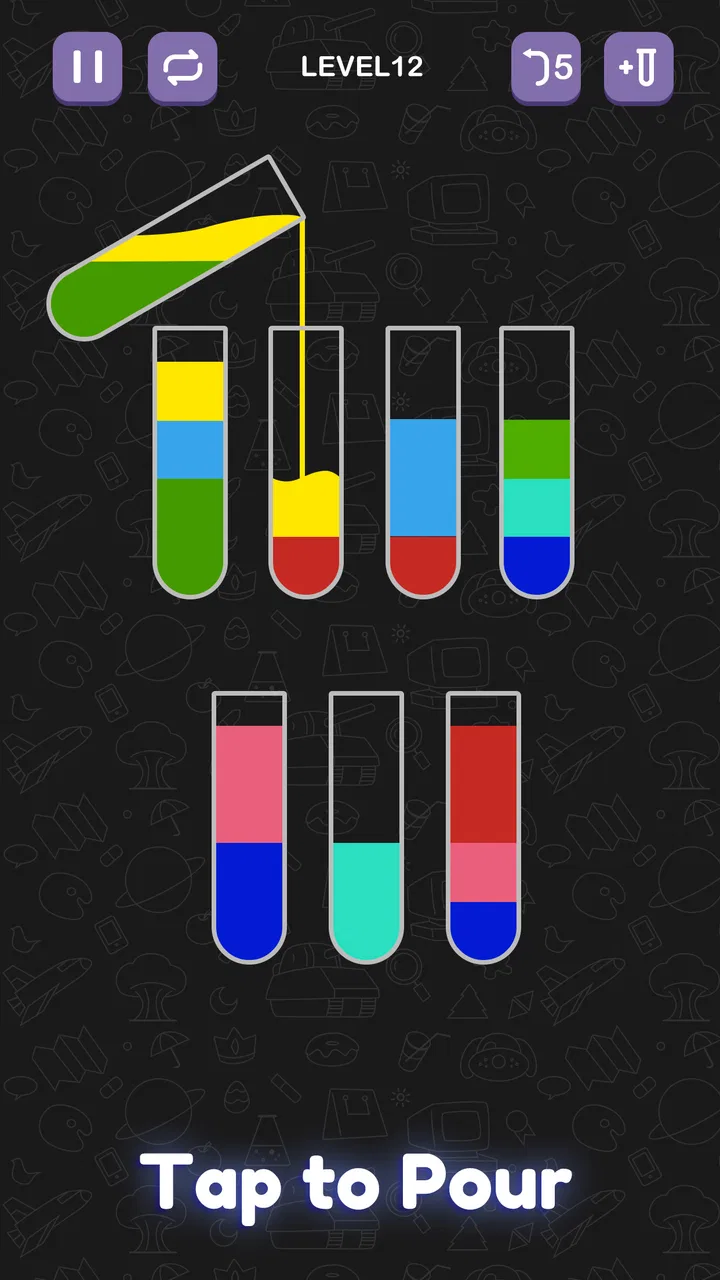
I spent time with Water Sort Puzzle - Sort Color as a quiet, pick-up-and-play puzzle rather than a game built around speed or complex controls. The basic task is simple: move colored liquid between tubes until matching colors are grouped together. That simplicity is exactly what makes it approachable, but it also means the experience depends heavily on how comfortably you can distinguish colors, follow the board, and tolerate repetition.
Developed by Guru Puzzle Game, this free puzzle title is aimed at Everyone and works on Android devices running version 7.0 or later. It has grown into a very familiar choice in its category, with an average rating of 4.9 from around 502 thousand ratings and more than 10 million installs. Those figures suggest broad appeal, but they do not remove the need to ask a more useful question: does its presentation suit the way you personally see, hear, move, and concentrate?
How the puzzle feels to use in everyday play
I find the everyday appeal of this puzzle less about chasing a score and more about making a crowded arrangement easier to read, one deliberate move at a time. That makes the way each pour changes the board worth considering: a choice can tidy one tube while narrowing the options elsewhere. With that in mind, the next section looks at how to keep the puzzle manageable during ordinary, stop-and-start play.
You May Also Like

 Blood Strike: 2.5 Anniversary
Blood Strike’s Loadouts Turn Every Drop Into a Tactical Gamble
A close look at Blood Strike’s custom loadouts: how fast access to signature weapons reshapes its battle royale rhythm, rewards preparation, and narrows the gap between fights.

 Pandora - Music & Podcasts
Pandora’s Music Is Easy to Start, but Harder to Recover
Pandora’s strength is its low-effort path from a seed to a station. Its weak spot is how much confidence it asks you to place in connection, setup, and quiet recovery.

 8 Ball Pool
 Is Built on Rivalries, Rematches, and Routine
A close look at the rivalries, rematches, shared routines, and unanswered safety questions that turn a quick pool match into a persistent mobile community.

 Samsung Music
’s Quiet Strength Is Playing What You Already Own
Its reach comes less from spectacle than from dependable access to a personal library. That simplicity is both the app’s strongest retention engine and its ceiling.

 AccuWeather: Weather Radar
AccuWeather Review: A Quick, Clear Forecast for Everyday Decisions
For everyday plans, the best forecast is the one you can understand quickly. AccuWeather makes rain timing, radar, and local conditions easy to act on, with a few trade-offs.

 Hill Climb Racing
Why Hill Climb Racing Still Turns Crashes Into One More Run
A tiny car, a bumpy hill and one more upgrade: Hill Climb Racing keeps resurfacing because its simple chaos makes every near-miss feel personal.
More From Our News Desk
View All News


Readable boards and straightforward navigation
The strongest part of the design is that I understood the central interaction almost immediately. The tubes are arranged as the main focus, and the goal is visible rather than hidden behind menus or instructions. I did not need to learn a complicated control scheme before starting. Selecting a tube and choosing where its liquid should go creates a rhythm that feels natural after a few moves.
That clarity matters for players who prefer predictable navigation. Instead of searching through several screens, I could concentrate on the current arrangement and plan one move ahead. The game’s puzzle format also avoids the visual overload found in many action games. There are no enemies rushing toward me, no timer demanding constant attention, and no large amount of text to read before each attempt.
Still, “simple” does not mean effortless to read. The board can become visually busy when several tubes contain multiple layers of color. I found myself pausing to check the order from top to bottom, especially after making a move that changed several possible routes. Someone with reduced visual acuity may find the small liquid sections harder to inspect than the overall layout suggests.
The colors carry most of the information. That is useful when the shades are clearly different, but it creates a barrier when two colors look close under a particular screen setting, lighting condition, or individual vision profile. Players who do not reliably distinguish colors may need to rely on position and memory, which makes an otherwise relaxed puzzle more demanding.
I also noticed that the game rewards careful observation more than fast reactions. That is good news for people who need extra time to process a board. A useful habit is to pause before tapping and identify the top available color in each tube. This reduces accidental moves and makes the puzzle easier to follow without turning it into a race.
Motor demands are light, but precision still matters
The control requirement is modest: I mainly tapped tubes in sequence rather than dragging objects rapidly across the screen. That makes the game more approachable than a platformer, rhythm title, or match-three game that expects repeated swipes at speed. Players with limited reaction speed may appreciate that the challenge comes from planning rather than timing.
There is nevertheless a precision requirement. A misplaced tap can select a different tube from the one I intended, particularly when the board is crowded or when I am using the phone with one hand. This is not a high-intensity motor challenge, but it can become frustrating for someone with tremors, reduced finger control, or difficulty maintaining a steady touch.
My best workaround was to rest the phone securely instead of holding it in the air. Playing on a table gave me a steadier view and made each tap more deliberate. I would also avoid trying to solve a level while walking, carrying something, or riding in a moving vehicle. The game is forgiving about speed, but not about consistently selecting the intended tube.
The lack of rapid movement makes it suitable for short sessions during a break. I could stop after a level without feeling that I had interrupted a larger real-time match. That makes it more practical for people who experience fatigue or need to divide play into small intervals.
Sound, color, and sensory comfort
The liquid-sorting idea has an inherently calming quality, and the game presents itself as an ASMR-style experience. I found the gentle presentation more suitable for winding down than for seeking excitement. Players who enjoy repetitive visual organization may find the act of arranging the tubes satisfying even when the puzzle itself is not especially difficult.
At the same time, sensory comfort is personal. A soothing sound or movement for one player can become distracting for another. If you are sensitive to repeated effects, prefer silent play, or need to keep your surroundings quiet, it is worth checking the in-game audio behavior on your own device and adjusting the phone’s sound as needed. I would not choose this title specifically for rich audio feedback; its main value is visual and logical.
The colors are attractive, but they are not merely decoration. They are the main language of the puzzle. That means the game is less inclusive for someone who cannot comfortably separate similar shades. A board with labels, patterns, or distinct symbols would offer another way to identify contents, but I would not assume those alternatives are available here. If color recognition is a serious concern, this is one of the first things I would test before committing to regular play.
Playing without a connection and in different situations
One practical strength is that the game is designed for play without Wi-Fi. I found that especially useful in places where connectivity is unreliable or where I simply wanted a self-contained distraction. It fits a commute, a waiting room, a flight, or a quiet moment at home better than a puzzle that depends on an active connection.
Offline play can also help people who want fewer interruptions from network-dependent content. I could open the game and focus on the board rather than worrying about whether a connection would interrupt the session. That said, offline suitability should not be confused with complete freedom from every possible interruption on a phone. Calls, notifications, battery limits, and the device’s own settings still affect the experience.
The game is free to download, with in-app purchases listed at $7.99 per item. That is important for households sharing devices or for anyone trying to avoid unexpected spending. I would treat the purchase option as a decision to make deliberately rather than tapping through quickly, especially if a child is using the phone. The Everyone age rating makes the title broadly approachable, but age suitability does not automatically mean purchase decisions are simple.
For a typical everyday scenario, I can imagine opening it during a ten-minute lunch break. I would solve one or two boards, stop when attention started to drift, and return later without needing to remember a story or a complex mission. That low commitment is one of its best qualities. It is also useful for someone who wants a mental reset but does not want a demanding competitive game.
Where the design may still exclude people
The biggest remaining barrier is the reliance on color as the primary identifier. This is not a minor detail that can be separated from the gameplay; sorting the shades is the gameplay. If the colors are difficult for you to distinguish, the puzzle can feel unfair rather than relaxing. I would recommend trying a few boards under the exact brightness and display settings you normally use before deciding whether it belongs in your routine.
Visual crowding is another concern. As the arrangement becomes more complicated, the player must track several layers, empty spaces, and possible transfers at once. Someone with attention difficulties may enjoy the clear rules but still find the accumulation of similar-looking tubes tiring. A practical approach is to solve from the top layer downward, keeping a mental note of which tube can serve as temporary space. That method reduces the need to scan the whole board repeatedly.
There is also a difference between low physical demand and low cognitive demand. The taps are simple, but planning can become surprisingly absorbing. Players with limited concentration may prefer short sessions and should not feel pressured to finish a difficult board in one sitting. The absence of a timer helps, yet the game can still encourage extended repetition because each solved arrangement leads naturally to another.
People who want strong narrative context, social interaction, or a wide range of puzzle mechanics may find the experience narrow. Compared with word puzzles, it offers less language practice. Compared with Sudoku, it depends more on spatial arrangement and color grouping than on written numbers. Compared with match-three games, it is slower and more deliberate, with less emphasis on chain reactions or quick recognition.
Those alternatives may be better depending on the player. I would choose Sudoku for someone who prefers symbols and written logic, a word game for someone who wants vocabulary-based stimulation, and an action puzzle for someone who needs more variety and movement. This game is a better fit for someone who enjoys organizing a finite set of objects and learning a small rule system deeply.
Tips that make the experience more manageable
My first useful tip is to treat empty tubes as working space, not as spare containers to fill immediately. A move that looks productive can remove the only room needed to separate a mixed stack later. Before pouring, I ask myself whether the destination will expose a useful color or simply create another blockage.
Second, I try to preserve flexibility near the beginning of a board. Moving every available layer as soon as possible is tempting, but it can leave the same colors buried under one another. Keeping at least one route open for temporary transfers often makes the later arrangement easier to understand.
Third, I use a slower visual scan when the colors feel similar. I compare the top layers first, then inspect the next layer only after deciding which move is legal and useful. This is less tiring than staring at every tube simultaneously, and it can help players who lose track when too many visual details compete for attention.
Finally, I would not judge the game only by the first easy boards. The early experience explains the rule, while later arrangements test whether the player can plan several transfers without closing off options. If you are reviewing it for a child, an older relative, or someone with visual or motor limitations, watch how they handle a more crowded board rather than assuming the opening tutorial represents the whole experience.
Who should try it and who should skip it
I would recommend this game to people who like calm logic puzzles, short offline sessions, and progress that comes from making a board more orderly. It is particularly appealing if you enjoy repeating a familiar action while gradually improving your planning. The free entry point also makes it easy to test without treating the download as a major commitment.
I would be more cautious about recommending it to anyone who struggles to distinguish colors, finds repeated visual arrangements tiring, or needs strong nonvisual feedback. I would also skip it if your main reason for playing is social competition, storytelling, or constant novelty. The core idea is focused, and that focus is either its appeal or its limitation.
The current version is 4.20.0, and the game has remained recognizable as a straightforward color-sorting puzzle rather than trying to become a different genre. That consistency is helpful for players who value familiarity. It also means I would not expect the experience to satisfy someone looking for a broad collection of unrelated modes.
My inclusive verdict
After using it, I see Water Sort Puzzle - Sort Color as an accessible idea with a few important practical qualifications. Its navigation is easy to understand, its motor demands are relatively gentle, and its lack of Wi-Fi requirement makes it convenient in many real-life situations. The absence of time pressure gives players room to think, which is a meaningful advantage for anyone who dislikes reflex-based challenges.
Its weakest point is equally clear: color recognition carries too much of the burden. The game can be comfortable for someone with ordinary color perception and a steady tapping hand, but it is not equally welcoming to every player simply because the rules are simple. Screen size, brightness, hand stability, concentration, and sensitivity to repeated sounds can all change the experience.
I would recommend trying the free version during a quiet moment, with the phone positioned securely and the display set to your normal comfort level. If the colors remain easy to separate and the board feels relaxing rather than tiring, this is a polished little time-filler. If identifying shades is difficult or you need richer alternative cues, another puzzle category may serve you better. For the right player, though, Guru Puzzle Game’s creation delivers a pleasantly focused way to turn a few spare minutes into calm, methodical problem-solving.
FAQs for Water Sort Puzzle - Sort Color
01What is Water Sort Puzzle - Sort Color?
Water Sort Puzzle - Sort Color is a casual puzzle game where players are tasked with sorting colored liquids into separate bottles. The game challenges your problem-solving skills and patience as you carefully pour colors from one container to another without mixing them, aiming to align all liquids of the same color in a single bottle.
02Is Water Sort Puzzle - Sort Color free to play?
Yes, Water Sort Puzzle - Sort Color is free to download and play on both Android and iOS platforms. However, the game contains in-app purchases and ads. Players can choose to make purchases to remove ads or acquire additional features that enhance gameplay, but these are entirely optional.
03How does the gameplay of Water Sort Puzzle - Sort Color work?
The gameplay involves a series of levels where the objective is to sort colored water into the correct order. Players tap on a bottle to pour its contents into another, but only if the colors match or the bottle is empty. The goal is to have each bottle filled with only one color, requiring strategic planning and foresight.
04Are there any strategies for solving puzzles in Water Sort Puzzle - Sort Color?
A good strategy is to always plan a few moves ahead and avoid unnecessary moves that could complicate the puzzle. Try to empty a bottle completely to use it as a temporary holding spot for colors you need to reposition. Observing patterns and planning strategically can help solve levels more efficiently.
05Can Water Sort Puzzle - Sort Color be played offline?
Yes, Water Sort Puzzle - Sort Color can be played offline, making it a perfect choice for entertainment when you don't have internet access. However, some features like in-app purchases or ad removal require an internet connection. Enjoy uninterrupted gameplay without the need for constant connectivity.
Pros
- Simple and intuitive gameplay.
- Visually appealing color graphics.
- No time limits; play at your pace.
- Offline mode available.
- Regular updates with new levels.
Cons
- Can become repetitive over time.
- Ads can be intrusive between levels.
- Limited hints available without purchase.
- May lack challenge for some players.
- No multiplayer or social features.

Water Sort Puzzle - Sort Color
Gallery